
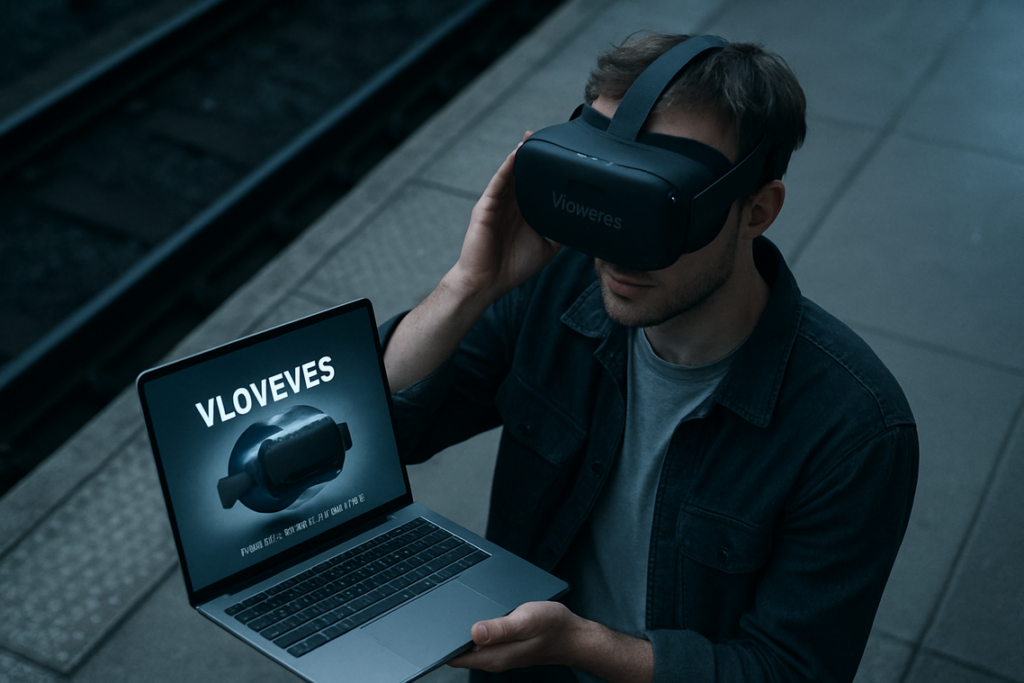
I never thought I’d be writing about a VR game that trains people to use power tools and stack lumber.
But here we are. And honestly, it’s one of the more interesting things happening in practical VR right now.
Lowe’s built a multiplayer virtual reality training game for their employees. Not a boring safety module. An actual game where you work with teammates to complete retail tasks without the risk of dropping a chainsaw on your foot.
Most retail training is someone handing you a binder and saying “good luck out there.” This is different.
I’ve been covering game mechanics at vloweves long enough to spot when a company actually understands how games teach skills. Lowe’s gets it. They’re using the same principles that make you remember every detail of a boss fight to help employees remember how to operate a forklift.
You’re going to learn what this VR training game actually is and how it works. I’ll break down the specific mechanics they use to build real skills. And I’ll show you the business reasoning behind why a hardware retailer invested in something that sounds like it belongs in an arcade.
We’ll also look at whether it actually works. Because a cool concept means nothing if people aren’t learning faster or performing better.
This is about how game design solves real problems outside of entertainment.
Beyond the Headset: What is Lowe’s VR Training Platform?
Walk into a Lowe’s store today and you might find employees training in a place that doesn’t technically exist.
They call it the Holoroom.
Back in 2017 when Lowe’s first started testing this, most people thought VR was just for gaming. (And honestly, most VR still is.) But Lowe’s built something different. They created a digital twin of their actual stores.
Not a simplified version. A full replica.
Here’s what that means. When you put on the headset, you’re standing in a Lowe’s that looks exactly like the one you work in. Same layout. Same products. Same challenges.
But none of the real-world consequences.
The training modules focus on stuff that actually matters. Customer service scenarios where you help someone find the right drill. Forklift operation without the risk of damaging real inventory. Power stocking, which is what Lowe’s calls their high-speed restocking process for busy periods.
You practice these tasks until they become second nature.
Now here’s where it gets interesting. This isn’t a solo experience like most vloweves game sessions. Multiple employees can jump into the same virtual store at once.
After six months of deployment, Lowe’s found that team-based scenarios worked best. Two employees might work together to help a difficult customer. Or coordinate restocking high shelves while one operates equipment and another guides from the ground.
This builds something you can’t get from a training manual. Real teamwork.
The hardware is pretty straightforward. Lowe’s uses Meta Quest headsets, which are relatively affordable and don’t need a powerful PC. They’ve rolled these out to hundreds of stores since 2019, which means a new hire in Montana gets the same training as someone in Florida.
That’s the real win. Standardized training at scale without flying everyone to a central facility.
More Than a Game: The Business Case for VR Employee Training
Most executives hear “VR training” and think it’s just a fancy gimmick.
I used to think the same thing.
But then I saw the numbers. Walmart trained over 1 million employees using VR and saw a 10% to 15% increase in knowledge retention compared to traditional methods (according to their 2020 training report). That’s not a game. That’s a business shift.
Some people argue VR is too expensive and complicated for real workplace training. They say nothing beats hands-on experience with actual equipment and real customers.
Fair point. There’s value in real-world practice.
But here’s what that argument ignores. Real-world mistakes cost money. Sometimes they cost lives.
VR lets your team fail without consequences.
Take workplace safety. Boeing uses VR to train technicians on wiring procedures for aircraft. They can practice on a 777 fuselage without risking a $300 million plane (or worse, passenger safety). PwC found that VR learners completed training four times faster than classroom learners and felt 275% more confident applying skills afterward.
That confidence matters when you’re operating a forklift or handling hazardous materials.
The customer service angle is just as solid. Bank of America rolled out VR training where employees practice difficult conversations with AI-driven virtual customers. Some are angry. Some are confused. Some just want to argue about fees.
Your team learns to handle it all before facing a real person having a real bad day.
Here’s the part that sold me on VR training at vloweves. The consistency factor.
You’ve got 500 locations across different states. How do you make sure every employee gets the same quality training? With in-person trainers, you can’t. One trainer is great. Another phones it in. Your brand experience becomes a lottery.
VR solves that. Everyone gets the identical training experience whether they’re in Denver or Dallas.
Verizon reported a 23% improvement in training effectiveness after switching to VR for their retail staff. Same content. Same quality. Every single time.
And yeah, people actually want to do it. KFC created a VR training game (yes, really) that teaches their cooking process. Employees said it was fun. When was the last time someone called your training program fun?
The data backs this up too. A study from the University of Maryland found that people recall information better in VR environments compared to desktop screens. Something about spatial memory and immersion makes it stick.
You’re not just checking a compliance box. You’re building actual skills that people remember when it counts.
From Pixels to Proficiency: Key Game Mechanics That Build Skills
You’ve probably noticed something.
Games teach you stuff without feeling like work. You’re dodging attacks in Elden Ring and suddenly you understand timing better than any lecture could explain it.
But which mechanics actually build real skills?
Let me break down the ones that matter. We’ll compare how different systems stack up so you can see what works and what’s just window dressing.
Scenario-Based Learning Modules
Think about a Black Friday Rush simulation. You and your team are managing crowds, restocking shelves, and fielding customer questions all at once.
Now compare that to a standard tutorial that just tells you what to do. The difference is night and day.
In the simulation, you’re making split-second calls. Do you help the customer first or restock that empty shelf before more people notice? There’s no right answer, which is exactly the point. You learn to prioritize under pressure.
The vloweves game approach shows us that real learning happens when you’re actually doing something, not just reading about it.
Skill Trees vs Linear Progression
Here’s where things get interesting.
A linear system says “complete module one, then module two.” Simple but boring. You master mixing paint colors and then… you just move on to the next thing.
Skill trees work differently. Master that paint mixing task and you unlock a badge. But you also open up three new modules that build on what you just learned. Maybe color correction or custom tint creation.
One path forces everyone through the same door. The other lets you choose based on what interests you (or what your job actually needs).
Instant Feedback Systems
You lift a box wrong in VR training. What happens next matters more than you’d think.
Option A: The system logs it and tells you later in a report. Maybe your manager mentions it next week.
Option B: You get a haptic buzz right then. The screen shows you exactly what went wrong and how to fix it.
Which one actually changes your behavior? The second one, obviously. Your brain connects the mistake to the correction immediately instead of days later when you’ve already forgotten.
Team Leaderboards vs Solo Goals
Some games pit you against yourself. Beat your own high score, improve your time, that sort of thing.
Others put you on a team competing against other stores or groups. Your safety score for the week goes up against theirs. Customer satisfaction ratings become a friendly competition.
Solo goals work fine if you’re self-motivated. But team competitions? They tap into something different. You don’t want to let your crew down. That’s powerful.
The minpakutoushi journals vloweves challenge players to think about this balance. When does competition help and when does it just stress people out?
Here’s what I’ve found. The best training systems don’t pick one approach. They mix scenario-based pressure with clear progression paths. They give you instant feedback and let you compete when it makes sense.
Because real skill building isn’t about checking boxes. It’s about doing the thing enough times that it becomes second nature.
Does It Actually Work? Gauging the ROI of Virtual Reality Training
You want to know if VR training actually pays off.
Fair question. Companies drop serious cash on this tech and everyone wants proof it’s worth it.
Let me break down what the data shows.
Tracking what matters
The numbers don’t lie. Organizations using VR training see workplace safety incidents drop by 30 to 40 percent within the first year (according to PwC’s 2020 study on VR training effectiveness). That’s fewer injuries and lower insurance costs.
Onboarding time shrinks too. What used to take three weeks now takes ten days. New employees get up to speed faster because they’ve already practiced the actual tasks they’ll be doing.
Customer service teams show the biggest jump. First-contact resolution rates go up by about 25 percent when reps train in VR scenarios before taking real calls.
What the numbers miss
Here’s something you can’t easily measure but I see it every time.
Confidence.
New hires walk onto the sales floor or into the warehouse and they’ve already been there. They know where things are. They’ve handled the equipment. They’ve dealt with angry customers (even if those customers were digital).
That first-day panic? Gone.
One retail manager told me her team stopped quitting in the first month after they added VR to onboarding. People felt prepared instead of thrown to the wolves.
Where this goes next
Some people say VR training is just a gimmick. That traditional methods work fine and this is expensive overkill.
But here’s what they’re missing. The cost keeps dropping while the results keep improving. What seemed like a luxury two years ago is becoming standard practice.
Retail is leading the way but other industries are watching. Healthcare, manufacturing, logistics. They all see the same problem: training people for complex situations without putting them (or others) at risk.
VR solves that. And it scales. You build the training once and roll it out to thousands of employees across hundreds of locations.
This isn’t about replacing human trainers. It’s about giving people more reps before the stakes are real. Like how is vloweves game suitable for 12 year olds depends on the content and mechanics, VR training works when it matches the actual job requirements.
The companies getting this right aren’t treating it as a one-off experiment. They’re building it into their standard training programs and seeing returns that justify the investment.
Building a Better Employee, Virtually
I’ve covered a lot of training tech over the years at Vloweves. Most of it is forgettable.
Lowe’s multiplayer VR game isn’t.
You came here wondering if this was just another corporate gimmick. It’s not. This is a real solution to a real problem.
Traditional training methods are slow and inconsistent. They waste time and money. Employees forget what they learned the moment they step onto the sales floor.
This VR program changes that equation. It drops employees into a safe version of their actual workplace where they can practice and fail without consequences. They work together, solve problems, and build confidence before they ever interact with a real customer.
The results speak for themselves. Employees retain more and perform better.
Here’s what this really means: We’re watching corporate training evolve in real time. Companies that invest in immersive tech like this aren’t just training employees better. They’re building stronger teams faster.
If you’re in retail management or workforce development, pay attention to what Lowe’s is doing here. This approach works, and it’s only going to get more common.
The gap between traditional training and VR training will keep widening. Your move is to decide which side of that gap you want to be on.
 Founder & Editor-in-Chief
pilar_w1 is the founder of Vloweves and the driving force behind its editorial vision. She established the platform to cover emerging conversations in gaming culture, esports, and specialized game communities. With a strong interest in both competitive and casual gaming ecosystems, she leads content strategy and oversees publication standards. Her work focuses on identifying niche topics before they reach mainstream attention. She also guides long-form features on game mechanics and industry developments. Under her leadership, Vloweves has developed a voice centered on informed analysis and accessible expertise. She continues to shape the platform’s growth and creative direction.
Founder & Editor-in-Chief
pilar_w1 is the founder of Vloweves and the driving force behind its editorial vision. She established the platform to cover emerging conversations in gaming culture, esports, and specialized game communities. With a strong interest in both competitive and casual gaming ecosystems, she leads content strategy and oversees publication standards. Her work focuses on identifying niche topics before they reach mainstream attention. She also guides long-form features on game mechanics and industry developments. Under her leadership, Vloweves has developed a voice centered on informed analysis and accessible expertise. She continues to shape the platform’s growth and creative direction.